
NIMCET 2010
The rate of increase of the length of the shadow of a man m high, due to a lamp at a height of m, when he is moving away from it at m/sec, is
Answer (Detailed Solution Below)View answer ▾Hide ▴
Answer: Option A — m/sec
Detailed Solution
Let the man be m from the lamp post and his shadow m long. Similar triangles give .
.
m/sec.
✓ Check
When goes from to (one second), goes from to : an increase of m.⚠ Common trap
(B) m/sec multiplies the walking speed by the height ratio instead of .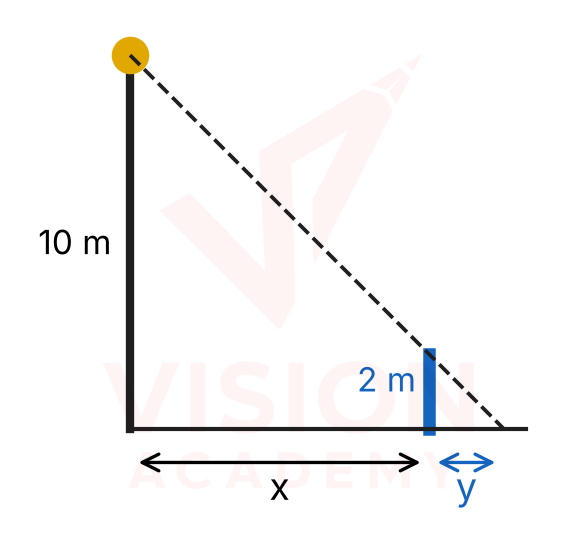
Quick tip
💬 Discussions on this question
Ask a doubt ›Still stuck on this question? Ask our faculty and fellow students — answers appear here.
Ask a doubtMore Applications of Derivatives Questions
View all ›- Q1.Find the acute angle at which the curves and intersect.
- Q2.Let be defined by . Then which of the following statements is true?
- Q3.The population of a town grows at per year. How long will it take for the population to triple?
- Q4.The sum of two numbers is . Their product will be maximum when they are
- Q5.The maximum value of is
More Quantitative Aptitude Questions
- Q1.By selling 45 lemons for ₹40, a man loses 20%. How many lemons should he sell for ₹24 to gain 20%?Profit, Loss & Discount
- Q2.The marked price of an article is 1.45 times its cost price. Its selling price is ₹1,500 and the profit is 25%. What is the discount percentage? Profit, Loss & Discount
- Q3.Let A be a real number. Then the roots of the equation are real and distinct if and only if Quadratic Equations
- Q4.The number of distinct real roots of the equation is Quadratic Equations
- Q5.The roots of are:Quadratic Equations
Applications of Derivatives — Preparation
This question tests your understanding of Applications of Derivatives, a key topic in the Quantitative Aptitude section. The detailed solution above uses a step-by-step approach to show the reasoning, and where available, a shortcut that helps you solve similar questions in under 90 seconds during the actual exam.
This topic uses derivatives to solve practical and geometric problems. It covers the equations of tangents and normals to a curve, the rate of change of quantities (such as how fast the area of a circle grows as its radius increases), approximations using differentials, and increasing and decreasing functions. It also covers maxima and minima, using the first derivative test and the second derivative test, and word problems on optimisation such as finding the largest area for a fixed perimeter. Rolle's theorem and the mean value theorem are included as well. For maxima and minima, set f'(x) = 0 to find the critical points, then check f''(x): a negative value means a maximum and a positive value means a minimum. Remember that the slope of the tangent at a point is f'(x) and the slope of the normal is -1/f'(x). Practise the applications of derivatives questions below, each with a step-by-step solution.