
NIMCET 2008
The area of the plane region bounded by , and is
Answer (Detailed Solution Below)View answer ▾Hide ▴
Answer: Option B —
Detailed Solution
The top boundary is ; the bottom is on and on ; the -axis closes the region on the left and the curves meet at .
Area under the top curve: .
Subtract and : Area .
✓ Check
On the top curve lies between and , so the area under it must lie between and ; does.⚠ Common trap
Dropping the constant of the top curve and ignoring the bottom curves gives , option (D).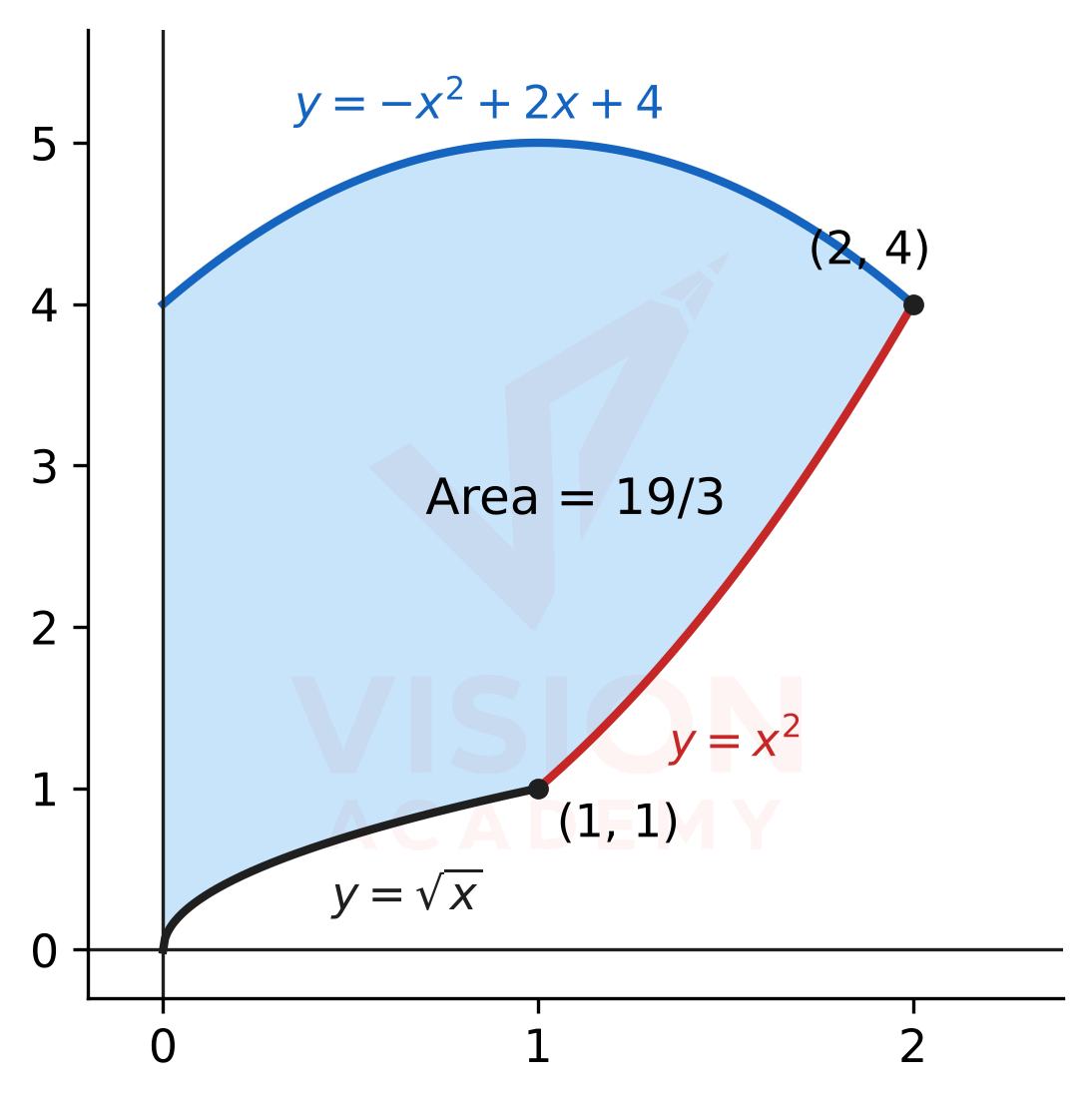
Quick tip
Area
💬 Discussions on this question
Ask a doubt ›Still stuck on this question? Ask our faculty and fellow students — answers appear here.
Ask a doubtMore Application of Definite Integration Questions
View all ›More Quantitative Aptitude Questions
- Q1.By selling 45 lemons for ₹40, a man loses 20%. How many lemons should he sell for ₹24 to gain 20%?Profit, Loss & Discount
- Q2.The marked price of an article is 1.45 times its cost price. Its selling price is ₹1,500 and the profit is 25%. What is the discount percentage? Profit, Loss & Discount
- Q3.Let A be a real number. Then the roots of the equation are real and distinct if and only if Quadratic Equations
- Q4.The number of distinct real roots of the equation is Quadratic Equations
- Q5.The roots of are:Quadratic Equations
Application of Definite Integration — Preparation
This question tests your understanding of Application of Definite Integration, a key topic in the Quantitative Aptitude section. The detailed solution above uses a step-by-step approach to show the reasoning, and where available, a shortcut that helps you solve similar questions in under 90 seconds during the actual exam.
This topic uses definite integrals to find the area of regions in the plane. It covers the area under a curve and above the x-axis, the area between a curve and the y-axis, the area between two curves, and the areas of standard regions bounded by circles, parabolas, ellipses and straight lines. Always start with a rough sketch of the region and find where the curves intersect, since those points become the limits of integration. For the area between two curves, integrate (upper curve - lower curve) between their intersection points. If part of a curve lies below the x-axis, take the absolute value of that part separately rather than integrating straight across, or the positive and negative areas will cancel. Useful standard results include the area of the ellipse x^2/a^2 + y^2/b^2 = 1, which is pi ab. Practise the area under the curve questions below, each with a sketch and a step-by-step solution.