
MAH MCA CET 2023
; then the points are
Answer (Detailed Solution Below)View answer ▾Hide ▴
Answer: Option A — Collinear
Detailed Solution
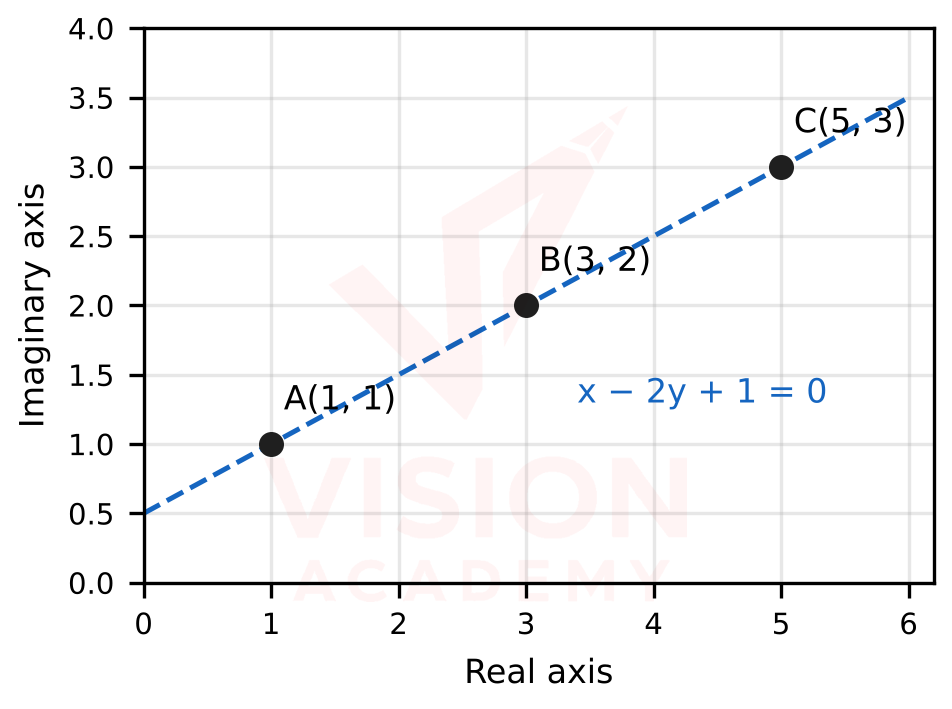
Plot them as points: , , .
Slope of
Slope of
Equal slopes and a common point , so , , lie on one line, .
✓ Check
, so is the midpoint of .Quick tip
collinear if is real
💬 Discussions on this question
Ask a doubt ›Still stuck on this question? Ask our faculty and fellow students — answers appear here.
Ask a doubtMore Complex Numbers Questions
View all ›More Quantitative Aptitude Questions
- Q1.By selling 45 lemons for ₹40, a man loses 20%. How many lemons should he sell for ₹24 to gain 20%?Profit, Loss & Discount
- Q2.The marked price of an article is 1.45 times its cost price. Its selling price is ₹1,500 and the profit is 25%. What is the discount percentage? Profit, Loss & Discount
- Q3.Let A be a real number. Then the roots of the equation are real and distinct if and only if Quadratic Equations
- Q4.The number of distinct real roots of the equation is Quadratic Equations
- Q5.The roots of are:Quadratic Equations
Complex Numbers — Preparation
This question tests your understanding of Complex Numbers, a key topic in the Quantitative Aptitude section. The detailed solution above uses a step-by-step approach to show the reasoning, and where available, a shortcut that helps you solve similar questions in under 90 seconds during the actual exam.
A complex number has the form z = a + ib, where a and b are real numbers and i is the imaginary unit with i^2 = -1. This topic covers powers of i (which repeat in a cycle of four: i, -1, -i, 1), algebra of complex numbers, the conjugate, the modulus |z| = sqrt(a^2 + b^2), and the argument (amplitude). It also covers the polar and exponential forms of a complex number, De Moivre's theorem, the cube roots of unity (1, omega and omega^2, where 1 + omega + omega^2 = 0 and omega^3 = 1), square roots of complex numbers, and representing complex numbers in the Argand plane. Questions involving powers of omega are very common, and the two identities above solve most of them in a line or two. For the argument, always check the quadrant of the point before deciding the angle. Practise the complex numbers questions below, each with a step-by-step solution.