
MAH MCA CET 2023
If and , then is
Answer (Detailed Solution Below)View answer ▾Hide ▴
Answer: Option C — Onto but not one-one
Detailed Solution
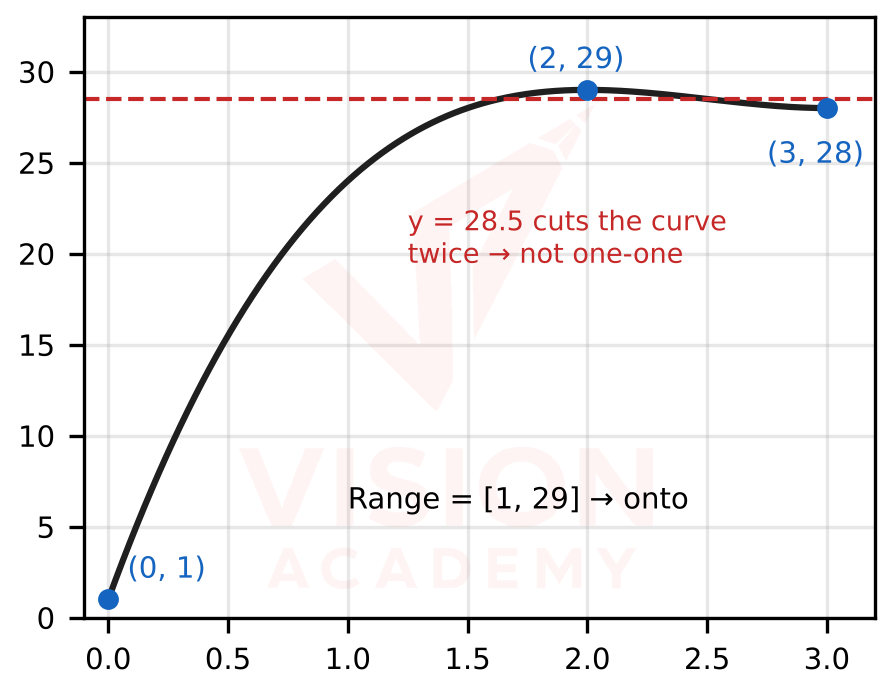
On , (increasing); on , (decreasing).
, ,
Step 4 (onto): the function rises from 1 to 29 and then falls to 28, so its range is , the whole co-domain. Hence onto.
Step 5 (not one-one): the value 28.5 is taken once between 0 and 2 and again between 2 and 3. Hence not one-one.
⚠ Common trap
Seeing the 'rise then fall' and stopping at 'not one-one' — the range still covers all of .Quick tip
Onto: range = co-domain; one-one fails if changes sign in the interval
💬 Discussions on this question
Ask a doubt ›Still stuck on this question? Ask our faculty and fellow students — answers appear here.
Ask a doubtMore Functions Questions
View all ›More Quantitative Aptitude Questions
- Q1.By selling 45 lemons for ₹40, a man loses 20%. How many lemons should he sell for ₹24 to gain 20%?Profit, Loss & Discount
- Q2.The marked price of an article is 1.45 times its cost price. Its selling price is ₹1,500 and the profit is 25%. What is the discount percentage? Profit, Loss & Discount
- Q3.Let A be a real number. Then the roots of the equation are real and distinct if and only if Quadratic Equations
- Q4.The number of distinct real roots of the equation is Quadratic Equations
- Q5.The roots of are:Quadratic Equations
Functions — Preparation
This question tests your understanding of Functions, a key topic in the Quantitative Aptitude section. The detailed solution above uses a step-by-step approach to show the reasoning, and where available, a shortcut that helps you solve similar questions in under 90 seconds during the actual exam.
A function assigns exactly one output to each input in its domain. This topic covers the domain, codomain and range of a function, types of functions (one-one, onto, even and odd functions), and standard functions such as the identity, constant, polynomial, rational, modulus, signum, greatest integer, exponential and logarithmic functions, along with their graphs. It also covers the composition of functions, the inverse of a function, and finding the domain and range of a given expression. For the domain, look for values that make a denominator zero, the expression under a square root negative, or the argument of a logarithm non-positive, and exclude them. A function has an inverse only if it is both one-one and onto. Quick graph sketches help a great deal with questions on range and on the number of solutions of an equation. Practise the functions questions below, each with a step-by-step solution.