
NIMCET 2008
What is the diameter of the largest circle that can be drawn on a chessboard so that its entire circumference gets covered by the black squares and no part of the circumference falls on any white space, given that the chessboard has black and white squares of side one inch?
Answer (Detailed Solution Below)View answer ▾Hide ▴
Answer: Option C — inches
Detailed Solution
The circle can pass from one black square to the next only through a shared corner, since black squares touch only diagonally.
Centre the circle at the centre of a black square. The corners at offsets and are all at distance .
The circle of radius goes through these corners and between them stays inside black squares, so its diameter is inches.
✓ Check
.⚠ Common trap
Options (A) and (B) also fit on black squares (a circle inside one black square; a circle through the four corners of a white square), but they are smaller than .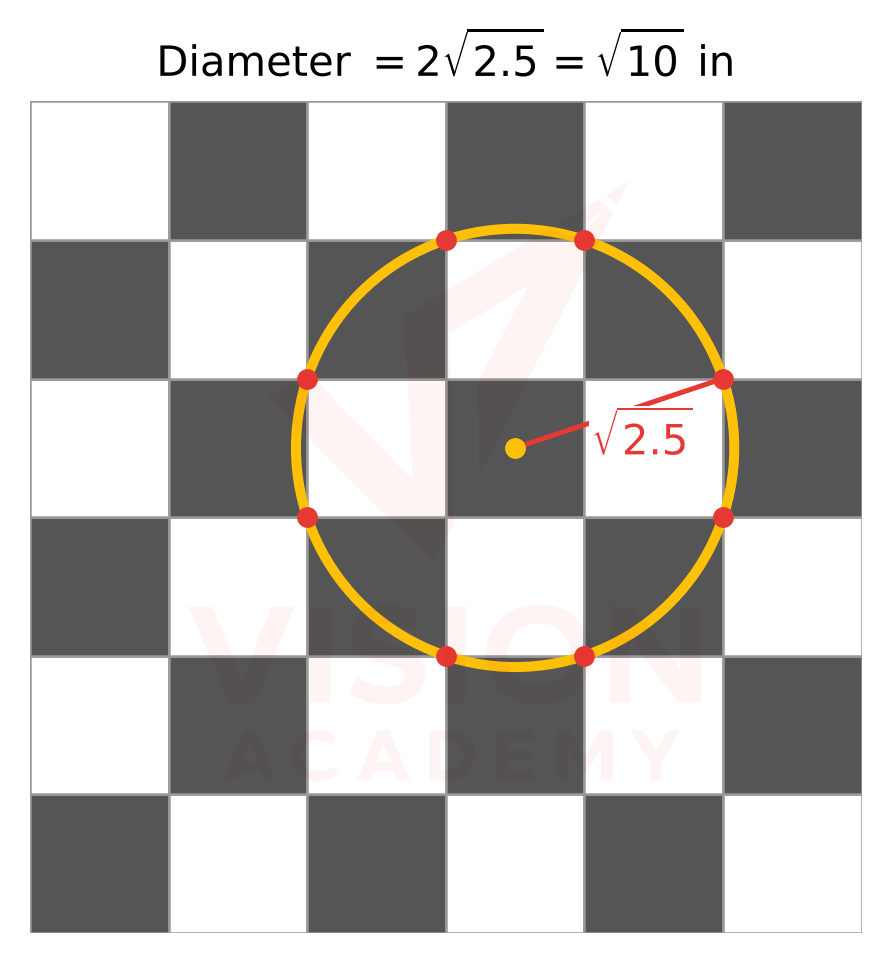
Quick tip
Radius through corners :
💬 Discussions on this question
Ask a doubt ›Still stuck on this question? Ask our faculty and fellow students — answers appear here.
Ask a doubtMore Geometry Questions
View all ›- Q1.Let be a point inside the triangle . Then which one of the following is true?
- Q2.Each interior angle of a regular hexagon measures
- Q3.In triangle ABC, D and E are points on AB and AC such that DE ∥ BC. If AD = 3 cm, DB = 2 cm and AE = 4.5 cm, then EC is
- Q4.The length of the tangent drawn from a point 13 cm away from the centre of a circle of radius 5 cm is
- Q5.In a parallelogram ABCD, P is the midpoint of AD. Also, BP and AC intersect at Q. Then AQ : QC =
More Quantitative Aptitude Questions
- Q1.By selling 45 lemons for ₹40, a man loses 20%. How many lemons should he sell for ₹24 to gain 20%?Profit, Loss & Discount
- Q2.The marked price of an article is 1.45 times its cost price. Its selling price is ₹1,500 and the profit is 25%. What is the discount percentage? Profit, Loss & Discount
- Q3.Let A be a real number. Then the roots of the equation are real and distinct if and only if Quadratic Equations
- Q4.The number of distinct real roots of the equation is Quadratic Equations
- Q5.The roots of are:Quadratic Equations
Geometry — Preparation
This question tests your understanding of Geometry, a key topic in the Quantitative Aptitude section. The detailed solution above uses a step-by-step approach to show the reasoning, and where available, a shortcut that helps you solve similar questions in under 90 seconds during the actual exam.
Geometry in entrance exams covers lines and angles, triangles, quadrilaterals, polygons and circles. Questions test properties of angles formed by parallel lines, congruence and similarity of triangles, the Pythagorean theorem, properties of special quadrilaterals, interior and exterior angles of polygons, and circle theorems such as angles in the same segment and tangent properties. Most geometry questions are solved by recognising the right property, not by long calculation. A neat rough diagram, labelled with the given information, often reveals the answer. Pythagorean triplets (3-4-5, 5-12-13, 8-15-17) and the 30-60-90 and 45-45-90 triangle ratios are worth memorising because they appear repeatedly. Practise the geometry questions below. Each comes with a step-by-step solution that names the property used.