
MAH MCA CET 2025
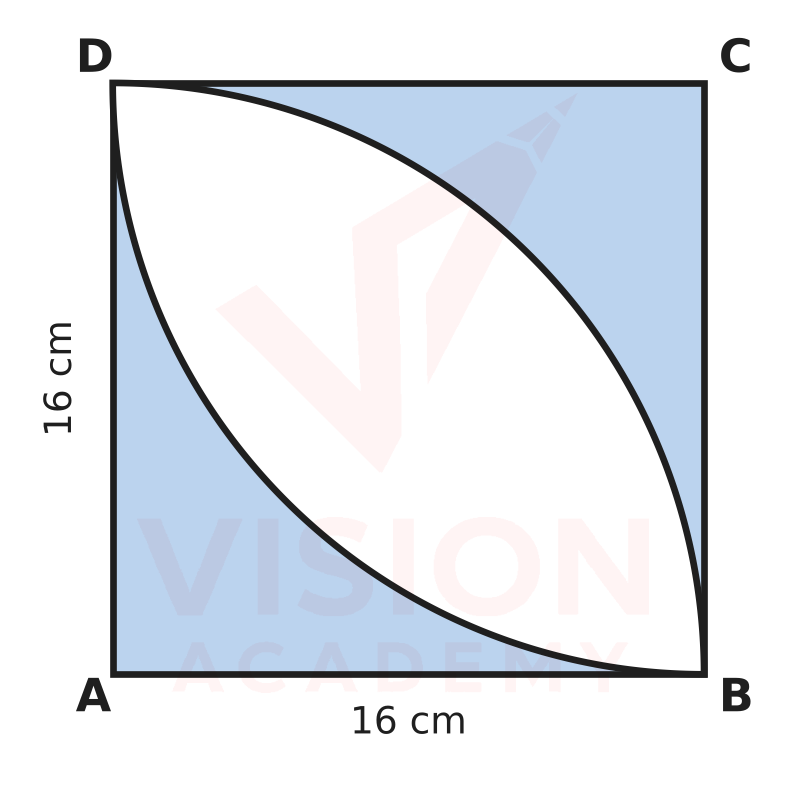
Calculate the area other than the area common between two quadrants of circles of radius 16 cm each, which is shown as the shaded region in the figure given.
Answer (Detailed Solution Below)View answer ▾Hide ▴
Answer: Option C —
Detailed Solution
The two quadrants of radius 16 are drawn from opposite corners of a square of side 16. Their common part (the leaf) is .
With : leaf .
Shaded area .
✓ Check
Each shaded piece is the square minus one quadrant: , and .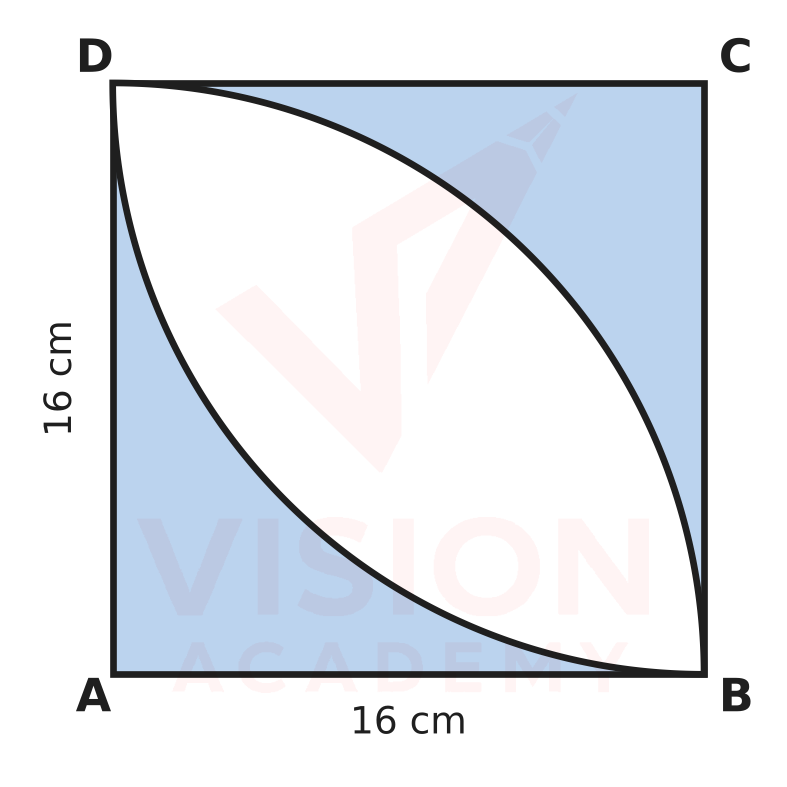
Quick tip
💬 Discussions on this question
Ask a doubt ›Still stuck on this question? Ask our faculty and fellow students — answers appear here.
Ask a doubtMore Basic Mensuration Questions
View all ›- Q1.A pendulum swings through an angle of and describes an arc of in length. Find the length of the pendulum.
- Q2.Two cubes each of volume are joined end to end. Find the surface area of the resulting cuboid.
- Q3.A circular wire of radius is cut and bent to lie along the circumference of a hoop of radius . Find (in degrees) the angle subtended at the hoop’s centre.
- Q4.A pendulum swings through an angle of and describes an arc of in length. Find the length of the pendulum.
- Q5.A circular wire of radius is cut and bent to lie along the circumference of a hoop of radius . Find (in degrees) the angle subtended at the hoop's centre.
More Quantitative Aptitude Questions
- Q1.By selling 45 lemons for ₹40, a man loses 20%. How many lemons should he sell for ₹24 to gain 20%?Profit, Loss & Discount
- Q2.The marked price of an article is 1.45 times its cost price. Its selling price is ₹1,500 and the profit is 25%. What is the discount percentage? Profit, Loss & Discount
- Q3.Let A be a real number. Then the roots of the equation are real and distinct if and only if Quadratic Equations
- Q4.The number of distinct real roots of the equation is Quadratic Equations
- Q5.The roots of are:Quadratic Equations
Basic Mensuration — Preparation
This question tests your understanding of Basic Mensuration, a key topic in the Quantitative Aptitude section. The detailed solution above uses a step-by-step approach to show the reasoning, and where available, a shortcut that helps you solve similar questions in under 90 seconds during the actual exam.
Basic mensuration deals with the perimeter and area of two-dimensional shapes: squares, rectangles, triangles, parallelograms, rhombuses, trapeziums, circles, sectors and rings. Exam questions test direct use of formulas, the effect of changing dimensions (for example, what happens to the area of a circle when its radius increases by 10%), paths running inside or outside a rectangular field, and the cost of fencing, flooring or painting. Knowing the formulas thoroughly is essential, and ratio reasoning makes questions on changing dimensions quick to solve. Remember that when every length is multiplied by k, the area is multiplied by k^2. Heron's formula for a triangle's area from its three sides and the area of an equilateral triangle, (sqrt 3 / 4) a^2, are worth memorising. Three-dimensional solids are covered separately on the Volume & Surface Area page. Practise the mensuration questions below on area and perimeter, each with a step-by-step solution.