
MAH MCA CET 2025
The number of parallelograms formed by a set of parallel lines intersecting another set of parallel lines is
Answer (Detailed Solution Below)View answer ▾Hide ▴
Answer: Option D — 18
Detailed Solution
A parallelogram needs 2 lines from each set.
.
✓ Check
With 2 lines in each set there is exactly parallelogram, as expected.⚠ Common trap
Option (C), 12, is , the number of intersection points.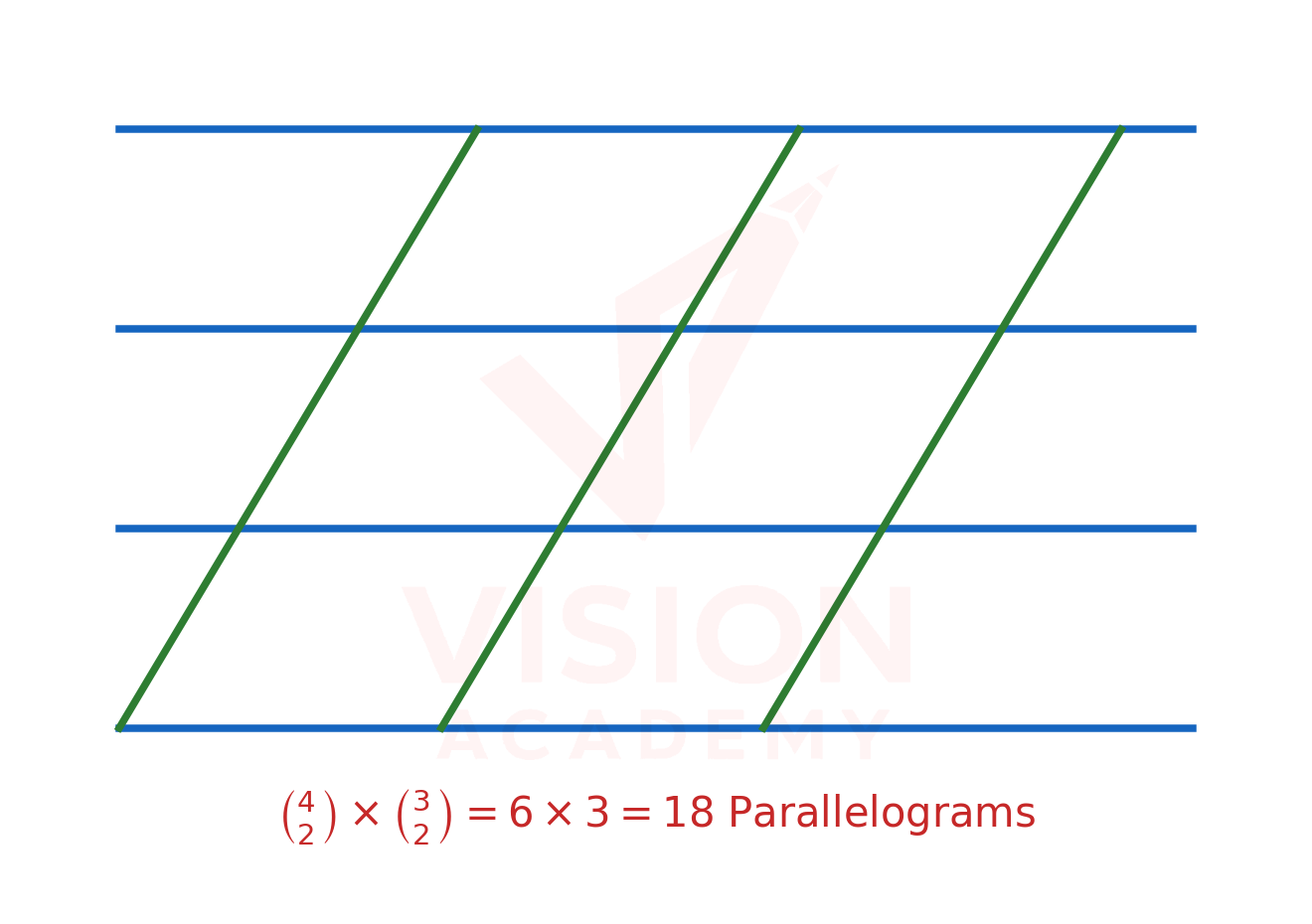
Quick tip
💬 Discussions on this question
Ask a doubt ›Still stuck on this question? Ask our faculty and fellow students — answers appear here.
Ask a doubtMore Permutations & Combinations Questions
View all ›- Q1.The number of diagonals in a polygon of sides is
- Q2.A five-digit number divisible by 3 is to be made using the digits 0, 1, 2, 3, 4, 5 without repetition. Find the number of such numbers.
- Q3.Let be the number of injective functions sending an even number to an even number. If , then is:
- Q4.Find the total number of ways to put balls into boxes so that the first box contains only one ball.
- Q5.Find the number of arrangements of the letters of the word such that
More Quantitative Aptitude Questions
- Q1.By selling 45 lemons for ₹40, a man loses 20%. How many lemons should he sell for ₹24 to gain 20%?Profit, Loss & Discount
- Q2.The marked price of an article is 1.45 times its cost price. Its selling price is ₹1,500 and the profit is 25%. What is the discount percentage? Profit, Loss & Discount
- Q3.Let A be a real number. Then the roots of the equation are real and distinct if and only if Quadratic Equations
- Q4.The number of distinct real roots of the equation is Quadratic Equations
- Q5.The roots of are:Quadratic Equations
Permutations & Combinations — Preparation
This question tests your understanding of Permutations & Combinations, a key topic in the Quantitative Aptitude section. The detailed solution above uses a step-by-step approach to show the reasoning, and where available, a shortcut that helps you solve similar questions in under 90 seconds during the actual exam.
Permutations count arrangements where order matters, while combinations count selections where order does not matter. This topic covers the fundamental principle of counting, factorials, nPr and nCr, arrangements of letters in a word (including repeated letters), circular arrangements, and selecting committees or teams with conditions. The hardest part is deciding whether a question needs a permutation or a combination. Ask yourself whether swapping two chosen items gives a new outcome. If it does, order matters. Conditions such as "two people must sit together" are handled by treating them as a single unit, and "at least one" questions are usually easiest to solve as total minus none. Practise the permutation and combination questions below, each with a step-by-step solution showing how to set up the count.