
NIMCET 2018
In a survey where 100 students reported which subject they like, 32 students in total liked Mathematics, 38 students liked Business and 30 students liked Literature. Moreover, 7 students liked both Mathematics and Literature, 10 students liked both Mathematics and Business, 8 students liked both Business and Literature, and 5 students liked all three subjects. Then the number of students who liked exactly one subject is
Answer (Detailed Solution Below)View answer ▾Hide ▴
Answer: Option B — 65
Detailed Solution
Exactly two subjects: M and B only , M and L only , B and L only .
Only M , only B , only L .
Exactly one subject .
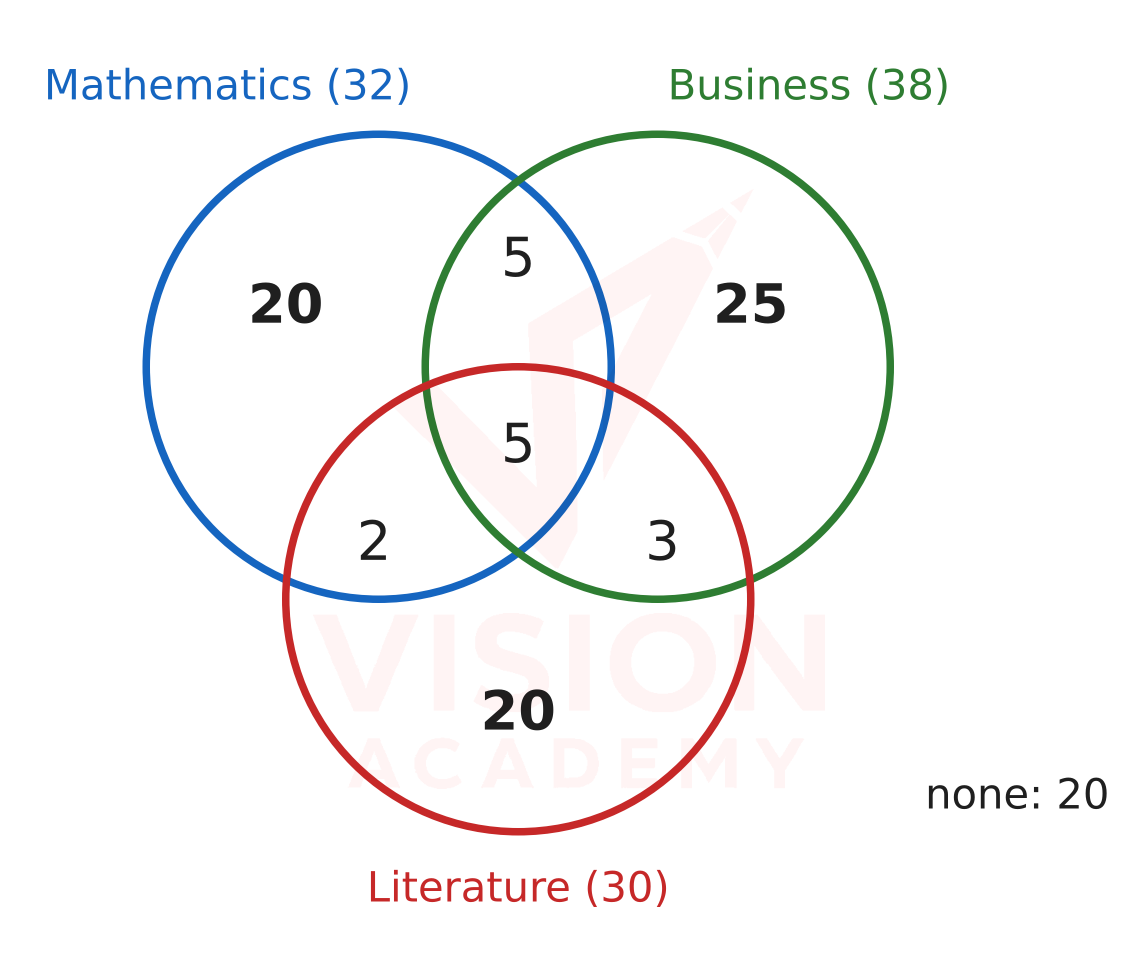
✓ Check
All regions add up to .⚠ Common trap
(D) 80 is the number who liked at least one subject.Quick tip
Only one
💬 Discussions on this question
Ask a doubt ›Still stuck on this question? Ask our faculty and fellow students — answers appear here.
Ask a doubtMore Set Theory Questions
View all ›More Quantitative Aptitude Questions
- Q1.By selling 45 lemons for ₹40, a man loses 20%. How many lemons should he sell for ₹24 to gain 20%?Profit, Loss & Discount
- Q2.The marked price of an article is 1.45 times its cost price. Its selling price is ₹1,500 and the profit is 25%. What is the discount percentage? Profit, Loss & Discount
- Q3.Let A be a real number. Then the roots of the equation are real and distinct if and only if Quadratic Equations
- Q4.The number of distinct real roots of the equation is Quadratic Equations
- Q5.The roots of are:Quadratic Equations
Set Theory — Preparation
This question tests your understanding of Set Theory, a key topic in the Quantitative Aptitude section. The detailed solution above uses a step-by-step approach to show the reasoning, and where available, a shortcut that helps you solve similar questions in under 90 seconds during the actual exam.
A set is a well-defined collection of objects. Set theory covers types of sets (finite, infinite, empty, singleton, equal and equivalent sets), subsets and power sets, and operations on sets such as union, intersection, difference and complement. It also covers De Morgan's laws and the cardinality formula n(A union B) = n(A) + n(B) - n(A intersection B). In entrance exams, the most common questions are word problems about people who like one, two or three activities, solved with Venn diagrams and the cardinality formula. Questions also ask for the number of subsets of a set (2^n for a set with n elements) and test set notation and properties. Practise the set theory questions below. Each comes with a step-by-step solution and a Venn diagram where it helps.