
MAH MCA CET 2024
The curved surface area of a glass having radii 3cm and 4cm respectively and slant height 10cm is
Answer (Detailed Solution Below)View answer ▾Hide ▴
Answer: Option C — 220 cm²
Detailed Solution
The glass is a frustum of a cone, so .
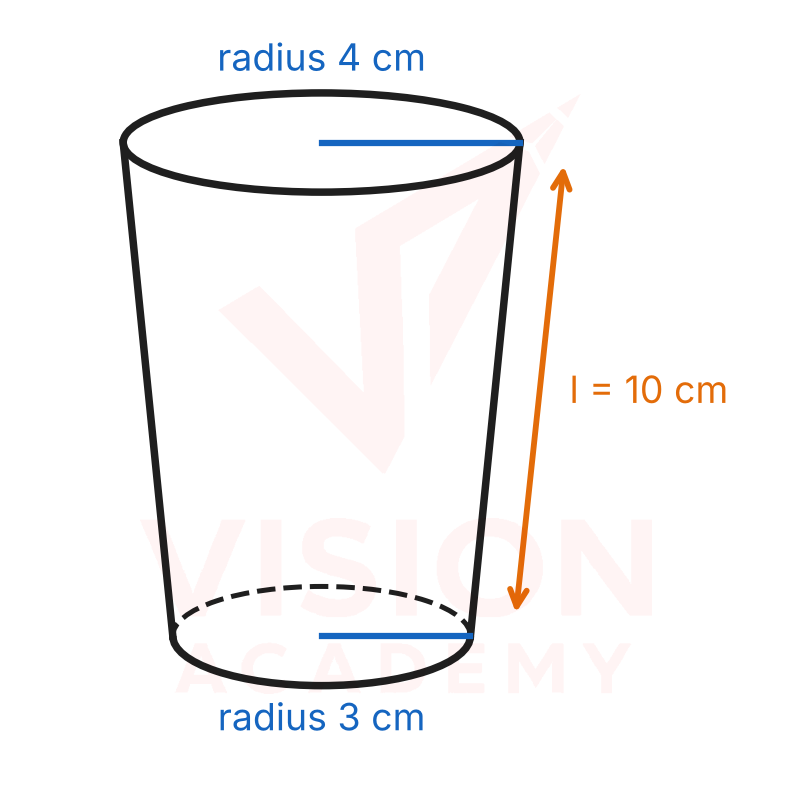
.
With : cm .
✓ Check
, which matches only option (C).⚠ Common trap
Option (B), 110 cm², comes from halving: , as if the formula were the area of a triangle.Quick tip
💬 Discussions on this question
Ask a doubt ›Still stuck on this question? Ask our faculty and fellow students — answers appear here.
Ask a doubtMore Volume & Surface Area Questions
View all ›- Q1.A block of is melted to form a sphere. Then the radius of the sphere is approximately ______.
- Q2.A cone of base radius 1 m and height 15 m is melted to form a sphere. The radius of the sphere is nearest to:
- Q3.Kartik has three solid objects: a cone, a hemisphere and a cylinder. All three have the same base radius and the same height. He completely immerses each solid in a bucket full of water. What is the ratio of the volumes of the cylinder : cone : hemisphere?
- Q4.Two cubes each of volume are joined end to end. Find the surface area of the resulting cuboid.
- Q5.A cylinder of radius 12cm contains water to a depth of 20cm. A spherical iron ball is dropped into the cylinder and thus the level of water is raised by 6.75cm. The radius of the ball is
More Quantitative Aptitude Questions
- Q1.By selling 45 lemons for ₹40, a man loses 20%. How many lemons should he sell for ₹24 to gain 20%?Profit, Loss & Discount
- Q2.The marked price of an article is 1.45 times its cost price. Its selling price is ₹1,500 and the profit is 25%. What is the discount percentage? Profit, Loss & Discount
- Q3.Let A be a real number. Then the roots of the equation are real and distinct if and only if Quadratic Equations
- Q4.The number of distinct real roots of the equation is Quadratic Equations
- Q5.The roots of are:Quadratic Equations
Volume & Surface Area — Preparation
This question tests your understanding of Volume & Surface Area, a key topic in the Quantitative Aptitude section. The detailed solution above uses a step-by-step approach to show the reasoning, and where available, a shortcut that helps you solve similar questions in under 90 seconds during the actual exam.
This topic covers the mensuration of three-dimensional solids: cubes, cuboids, cylinders, cones, spheres, hemispheres and frustums. You need to know the formulas for the volume, curved surface area and total surface area of each solid. For example, the volume of a cylinder is pi r^2 h and the volume of a sphere is (4/3) pi r^3. Exam questions test direct use of the formulas, melting one solid and recasting it into others (the volume stays the same), the number of small solids that can be made from a larger one, the effect of changing dimensions, water flowing through a pipe into a tank, and the cost of painting or covering a surface. When every length of a solid is multiplied by k, its surface area is multiplied by k^2 and its volume by k^3. This fact solves many questions about changing dimensions in a single step. Practise the volume and surface area questions below, each with a step-by-step solution.