
Two statements I and II are given below. Choose the option that correctly describes the relationship between them.I.Large number of people living in the low lying areas has been evacuated during the last few days to safer places.II.The Government has rushed in relief supplies to the people living in the affected areas.
Answer (Detailed Solution Below)View answer ▾Hide ▴
Answer: Option E — Both the statements I and II are effects of some common cause.
Detailed Solution
I is the evacuation of people from low-lying areas; II is relief supplies sent to the affected areas.
Both are responses to one calamity, most likely floods in the low-lying areas. Both are effects of that common cause.
✓ Check
The words "low lying areas" and "affected areas" point to a disaster behind both actions.⚠ Common trap
(A) treats evacuation as the reason for relief, but relief goes to people in the affected areas because of the calamity itself.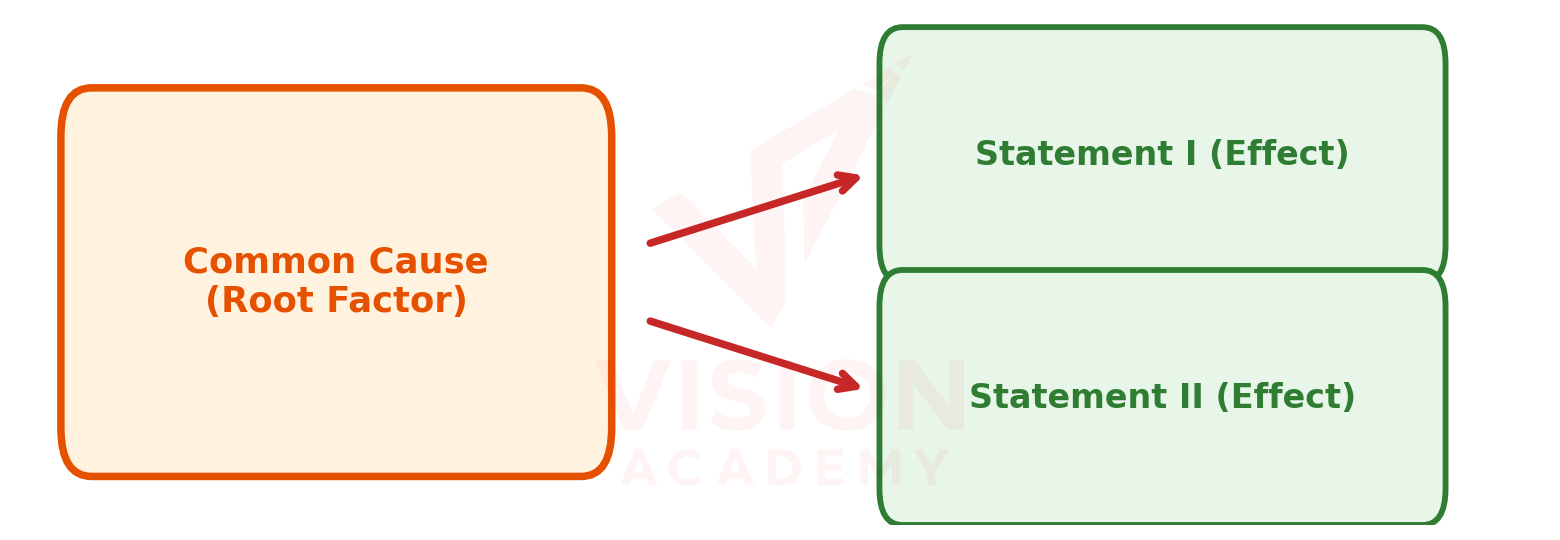
Quick tip
Evacuation and relief are both responses to one calamity (a flood in low-lying areas).
💬 Discussions on this question
Ask a doubt ›Still stuck on this question? Ask our faculty and fellow students — answers appear here.
Ask a doubtMore Cause and Effect Questions
View all ›- Q1.Two statements I and II are given below. Choose the option that correctly describes the relationship between them.
- Q2.Two statements I and II are given below. Choose the option that correctly describes the relationship between them.
- Q3.Two statements I and II are given below. Choose the option that correctly describes the relationship between them.
- Q4.Two statements I and II are given below. Choose the option that correctly describes the relationship between them.
- Q5.Two statements I and II are given below. Choose the option that correctly describes the relationship between them.
More Logical Reasoning Questions
- Q1.Six persons A, B, C, D, E, and F are sitting in a row facing north. B sits third to the left of F. A sits to the immediate right of B. D sits second to the right of F. E sits to the immediate right of A. Who sits at the extreme right end?Linear Arrangement
- Q2.Five friends P, Q, R, S, and T are standing in a row. P is to the left of Q but to the right of T. R is to the right of Q. S is between Q and R. Who is standing in the middle?Linear Arrangement
- Q3.Eight people 1 through 8 sit in a row. 3 sits exactly midway between 1 and 5. 5 sits to the immediate left of 7. 2 sits third to the right of 8. 6 sits to the immediate right of 2. 4 sits between 6 and 7. Who sits second from the left?Linear Arrangement
- Q4.A, B, C, D, and E are five houses in a row from left to right. C is to the right of B and to the left of E. A is to the left of B. D is to the right of E. Which house is in the middle?Linear Arrangement
- Q5.Seven students sit in a row. Priya is second from the right. Raj is third to the left of Priya. Meena is immediately to the right of Raj. Sam is between Meena and Priya. Two students sit to the left of Raj. Who sits at the extreme left?Linear Arrangement
Cause and Effect — Preparation
This question tests your understanding of Cause and Effect, a key topic in the Logical Reasoning section. The detailed solution above uses a step-by-step approach to show the reasoning, and where available, a shortcut that helps you solve similar questions in under 90 seconds during the actual exam.
Cause and effect is a logical deduction question type. You are given two statements, I and II, that describe events. One of them may be the cause of the other, or both may be effects of a common cause, or they may have no connection at all. You must decide how the two statements are related. The usual options are that I is the cause and II is its effect, II is the cause and I is its effect, both are effects of independent causes, both are effects of the same cause, or neither is a cause or an effect of the other. A cause is an event that happens first and makes the other event happen. An effect is the result. Ask yourself two questions: could statement I lead to statement II, and could II lead to I? The cause usually comes earlier in time, while the effect follows it. Words in the statements can help, such as "because", "as a result" and "due to". If both statements describe results of a third event that is not stated, such as a flood causing both school closures and a rise in vegetable prices, they are effects of the same cause. If the two events are simply unrelated, choose the option that says neither is a cause or an effect. Don't use outside assumptions to build a link that the statements do not support. Practise the cause and effect questions below. Each solution explains which statement is the cause and why.