
NIMCET 2017
There are five books A, B, C, D and E placed on a table. If A is placed below E, C is placed above D, B is placed below A and D is placed above E, then which of the following books touches the surface of the table?
Answer (Detailed Solution Below)View answer ▾Hide ▴
Answer: Option B — B
Detailed Solution
Combine the statements: B below A, A below E, E below D, D below C.
From the bottom: B, A, E, D, C. The bottom book B touches the table.
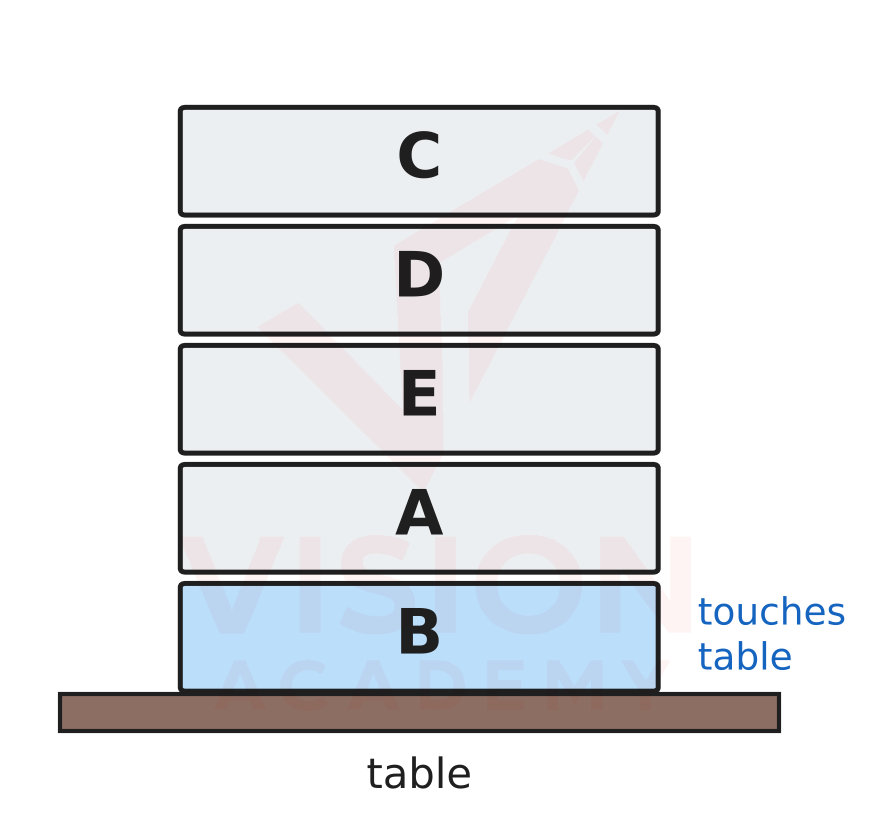
✓ Check
Each of the four statements holds in the order B, A, E, D, C.⚠ Common trap
(C) A is below E, but B is below A, so A is not at the bottom.Quick tip
Chain the 'below' facts: B, A, E, D, C from the bottom
💬 Discussions on this question
Ask a doubt ›Still stuck on this question? Ask our faculty and fellow students — answers appear here.
Ask a doubtMore Order & Ranking Questions
View all ›- Q1.In a row of trees, one tree is fifth from either end of the row. How many trees are there in the row?
- Q2.In a class, a student is ranked 35th from the top and 32nd from the bottom. How many students are there in the class?
- Q3.Five boxes P, Q, R, S, T are stacked one above the other. R is above S but below Q. T is at the bottom. P is just above T. Which box is at the top?
- Q4.Three persons A, B and C are standing in a queue. There are five persons between A and B and eight persons between B and C. If there are three persons ahead of C and 21 behind A, what could be the minimum number of persons in the queue?
- Q5.Shweta, Yamini, Pooja and Rakhi are sisters. Yamini is older than at least two of her sisters. Pooja is younger than Rakhi, who is not the oldest. Shweta is older than Pooja but younger than Rakhi. Who is the oldest among them?
More Logical Reasoning Questions
- Q1.Six persons A, B, C, D, E, and F are sitting in a row facing north. B sits third to the left of F. A sits to the immediate right of B. D sits second to the right of F. E sits to the immediate right of A. Who sits at the extreme right end?Linear Arrangement
- Q2.Five friends P, Q, R, S, and T are standing in a row. P is to the left of Q but to the right of T. R is to the right of Q. S is between Q and R. Who is standing in the middle?Linear Arrangement
- Q3.Eight people 1 through 8 sit in a row. 3 sits exactly midway between 1 and 5. 5 sits to the immediate left of 7. 2 sits third to the right of 8. 6 sits to the immediate right of 2. 4 sits between 6 and 7. Who sits second from the left?Linear Arrangement
- Q4.A, B, C, D, and E are five houses in a row from left to right. C is to the right of B and to the left of E. A is to the left of B. D is to the right of E. Which house is in the middle?Linear Arrangement
- Q5.Seven students sit in a row. Priya is second from the right. Raj is third to the left of Priya. Meena is immediately to the right of Raj. Sam is between Meena and Priya. Two students sit to the left of Raj. Who sits at the extreme left?Linear Arrangement
Order & Ranking — Preparation
This question tests your understanding of Order & Ranking, a key topic in the Logical Reasoning section. The detailed solution above uses a step-by-step approach to show the reasoning, and where available, a shortcut that helps you solve similar questions in under 90 seconds during the actual exam.
Order and ranking questions ask about a person's position in a row or class, or compare people by height, weight, age or marks. This topic covers ranks from the top and bottom (or left and right), the total number of people in a row, interchanging positions, and arranging people in order from a set of comparisons. The key formula is total = rank from top + rank from bottom - 1. When two people swap places, find the shift in one person's position to work out the total. For comparison questions, list the people from greatest to smallest as you read each clue, and use the symbols > and < to keep track. Watch for questions where the order cannot be fully determined. Practise the order and ranking questions below, each with a step-by-step solution.