
NIMCET 2023
StatementsNo table is chair.Not a single chair is stand.Every stand is statue.Conclusions1.Some statues which are stands are tables as well.2.Some statues are not chairs.
Answer (Detailed Solution Below)View answer ▾Hide ▴
Answer: Option B — Only conclusion 2 follows
Detailed Solution
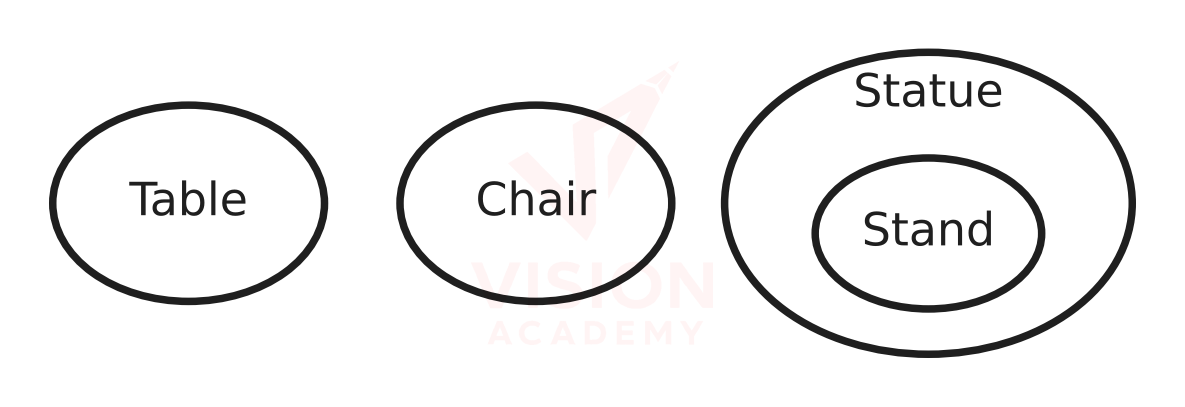
Every stand is a statue and no stand is a chair, so the statues that are stands are not chairs. Conclusion 2 follows.
Tables and stands are not linked to each other (both only exclude chairs), so 'some stands are tables' is just a possibility. Conclusion 1 does not follow.
✓ Check
In the diagram, Table and Stand are both kept away from Chair and Stand lies inside Statue; Table can sit outside Statue, so conclusion 1 can fail.⚠ Common trap
(D) Only conclusion 1 follows assumes tables and stands overlap because neither is a chair; two groups that both avoid chairs need not meet.💬 Discussions on this question
Ask a doubt ›Still stuck on this question? Ask our faculty and fellow students — answers appear here.
Ask a doubtMore Syllogism Questions
View all ›- Q1.Two statements are given below followed by two conclusions numbered (1) and (2). Which of the given conclusions logically follows from the two given statements? Please disregard commonly known facts.
- Q2.Let W, X, Y, Z be some entities.
- Q3.Statements:
- Q4.If every cat has a tail, and Fluffy is a cat, what can you conclude about Fluffy?
- Q5.Statements:
More Logical Reasoning Questions
- Q1.Six persons A, B, C, D, E, and F are sitting in a row facing north. B sits third to the left of F. A sits to the immediate right of B. D sits second to the right of F. E sits to the immediate right of A. Who sits at the extreme right end?Linear Arrangement
- Q2.Five friends P, Q, R, S, and T are standing in a row. P is to the left of Q but to the right of T. R is to the right of Q. S is between Q and R. Who is standing in the middle?Linear Arrangement
- Q3.Eight people 1 through 8 sit in a row. 3 sits exactly midway between 1 and 5. 5 sits to the immediate left of 7. 2 sits third to the right of 8. 6 sits to the immediate right of 2. 4 sits between 6 and 7. Who sits second from the left?Linear Arrangement
- Q4.A, B, C, D, and E are five houses in a row from left to right. C is to the right of B and to the left of E. A is to the left of B. D is to the right of E. Which house is in the middle?Linear Arrangement
- Q5.Seven students sit in a row. Priya is second from the right. Raj is third to the left of Priya. Meena is immediately to the right of Raj. Sam is between Meena and Priya. Two students sit to the left of Raj. Who sits at the extreme left?Linear Arrangement
Syllogism — Preparation
This question tests your understanding of Syllogism, a key topic in the Logical Reasoning section. The detailed solution above uses a step-by-step approach to show the reasoning, and where available, a shortcut that helps you solve similar questions in under 90 seconds during the actual exam.
Syllogism questions give two or more statements and ask which conclusions follow from them. You must accept the statements as true, even if they contradict real-world facts. This topic covers statements with "All", "Some" and "No", "only a few" type statements, and possibility conclusions such as "Some A can be B". The Venn diagram method is the most reliable approach. Draw every possible arrangement that satisfies the statements, and accept a conclusion only if it holds in every diagram. A possibility conclusion follows if it is true in at least one valid diagram. Knowing the standard rules, such as "All + All = All" and "Some + All = Some", speeds things up once you are confident with the diagrams. Practise the syllogism questions below. Each solution includes a Venn diagram.